

If you don’t see your question here, don’t hesitate to contact a member of our team – we’re happy to help!
The biggest energy users in a typical home include the following:
Tip: Since lighting makes up a significant portion of your energy useage contributing to 12% of your overall energy output it makes sense to have some basic upgrades done. We are available to discuss with you the areas you might realize savings from a lighting upgrade, while at the same time improve the use and aesthetics of your home.
Flickering lights can indicate loos wiring, overloaded circuits or issues with your electrical panel. It’s a good idea to have a licensed electrician inspect the issue to ensure your home stays safe.
The use of dimmers does save energy. By reducing the flow of electricity to the LED bulbs and allowing the lights to operate with lower power output you can reduce your energy consumption and save money on your electric bill. With a proper consultation, we can help you determine the areas in your home in which a dimmer can be utilized based on your lifestyle and your application needs.
The results of studies would validate that they do. You decide based on the results; an incandescent bulb left on for thirty minutes a day uses $1.48 in electricity a year. The LED bulb uses only 25 cents a savings of $1.23 per year. How many incandescent bulbs do you have in your house and how many hours a day are they left on? When you figure that out then LED can make a big impact in saving you money towards your household budget.
Also consider: LED’s convert 95% of the energy to light, leaving 5% being converted to heat. That’s a positive way to tip the scales in cooling rooms and your personal comfort.
Replacing un-grounded outlets with new Tamper Resistant, GFCI’s make sense. You can easily identify if your outlets have been upgraded by simply looking. If your outlets resemble the two-pronged entry points depicted in the first picture, you have an un-grounded outlet that you should consider replacing. If your outlets resemble the receptacle you see in the center picture you have a GFCI or a Ground Fault Circuit Interrupter outlet. This receptacle is ideal in the wet areas of your home. (unfinished basements, bathrooms, kitchens, exterior applications, laundry rooms, etc.)

Old Style Receptacle/Non-Tamper Resistant

GFTR/Recommended

GFTR/Recommended
A GFCI stands for Ground Fault Circuit Interrupter. This electrical device disconnects from the circuit when it detects that the flow of electricity is not in balance. GFCI’s are made to disconnect quickly to prevent injury or cause shocks. Note: They do not guard against the overload of the receptacle use.
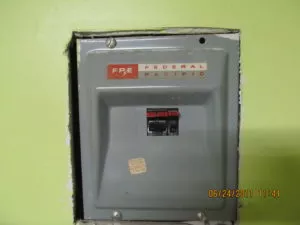
Federal Pacific Electric circuit breaker panels were the most common circuit breaker panels used in the U.S. from 1950 through the 1980s. Over time and as electrical needs increased the Federal Pacific Panel has proven to fail in providing the proper protection a homeowner requires for the safety of their homes and families.
It is recommended that a Federal Pacific Panel be replaced if you have one in your home. Almost always a homeowner will be required to change the panel upon the sale of their house due to its presence. Typically it does not pass the home inspection benchmark or due to not meeting current and up-dated code requirements.
Point Electric is happy to discuss with you in detail the replacement of your Federal Pacific Panel and the specific needs you have to safely bring your homes electrical needs up to date.
At Point Electric, we offer design-build services. It means we are capable of handling both the design and construction aspects of an electrical project. This approach differs from the traditional method where the design and construction phases are handled by separate entities (an architect/engineer for design and a contractor for construction). Learn all about our design-build services here.
Yes, most homes can support an EV charging station. In many cases, a licensed electrician can install a Level 2 charging station in your garage or on an exterior wall near your driveway. The installation typically involves connecting the charger to your home’s electrical panel and ensuring your system can safely handle the additional power demand.
One of our professional electricians can evaluate your electrical panel, wiring, and installation location to determine the best setup for your home.
Level 1 chargers use a standard 120-volt outlet and are typically included with most electric vehicles. While convenient, they charge vehicles slowly and can take more than 24 hours to fully recharge a battery.
Level 2 chargers use a 240-volt connection—similar to what powers large appliances like dryers—and can charge most electric vehicles significantly faster. Because of this, Level 2 chargers are the most common choice for residential EV charging installations.
Yes. Installing a Level 2 EV charger requires working directly with your home’s electrical system and typically involves adding a dedicated circuit to your electrical panel.
A licensed electrician ensures the installation is safe, up to code, and capable of handling the electrical load required for charging your vehicle.
As electric vehicles become more common, EV charging capability is increasingly viewed as a desirable home feature. Many homebuyers appreciate having the ability to charge a vehicle at home, especially in areas where EV ownership is growing.
Installing a charger can make your home more attractive to future buyers who already own—or plan to own—an electric vehicle.
Before installing an EV charging station, homeowners should consider a few key factors, including:
Working with a qualified electrician from Point Electric can help ensure your system is installed safely and designed for your specific vehicle and home layout.
If you’re considering installing an EV charging station at your home, the team at Point Electric can help evaluate your electrical system and recommend the right solution for your needs. Contact us to learn more about residential EV charger installation and schedule a consultation.
In many cases, yes. Design-build can shorten project timelines because design planning and installation preparation occur at the same time. Instead of waiting for design completion before construction begins, teams can coordinate materials, equipment, and scheduling early in the process.
This integrated approach often reduces delays and helps projects move from concept to completion more efficiently.
Yes. While design-build is commonly used for new construction, it is also an effective approach for building renovations, tenant improvements, and facility expansions.
An electrical design-build team can evaluate existing electrical infrastructure, determine what upgrades are required, and design a system that integrates seamlessly with the current building.
Project costs vary depending on the size of the building, electrical load requirements, system complexity, and equipment needed. Because design and installation are handled by the the Point Electric team, electrical design-build projects often produce more accurate budgets early in the process. This helps project owners avoid unexpected expenses later in construction.
The best way to determine cost is through an initial consultation where project scope, power requirements, and future expansion needs can be evaluated.
To view helpful and informative videos from Point Electric, visit our YouTube channel, or our Video Gallery!
